


 Date:2026.05.13
 Views: Loading


The industry progressed from 280 Ah cells (2019–2021 era) to 314 Ah cells (2022–2023 era). Each generation reduced system integration cost by packing more capacity into the same footprint. Now the market is entering the 500 Ah+ generation, and the engineering requirements change significantly at this scale.
Great Power's 587 Ah cell delivers 87% more capacity than a 314 Ah cell, enabling 6.25 MWh per 20-foot container. This large capacity battery cell is designed specifically for utility-scale BESS applications where system-level cost per megawatt-hour, not cell-level specifications, determines project economics.
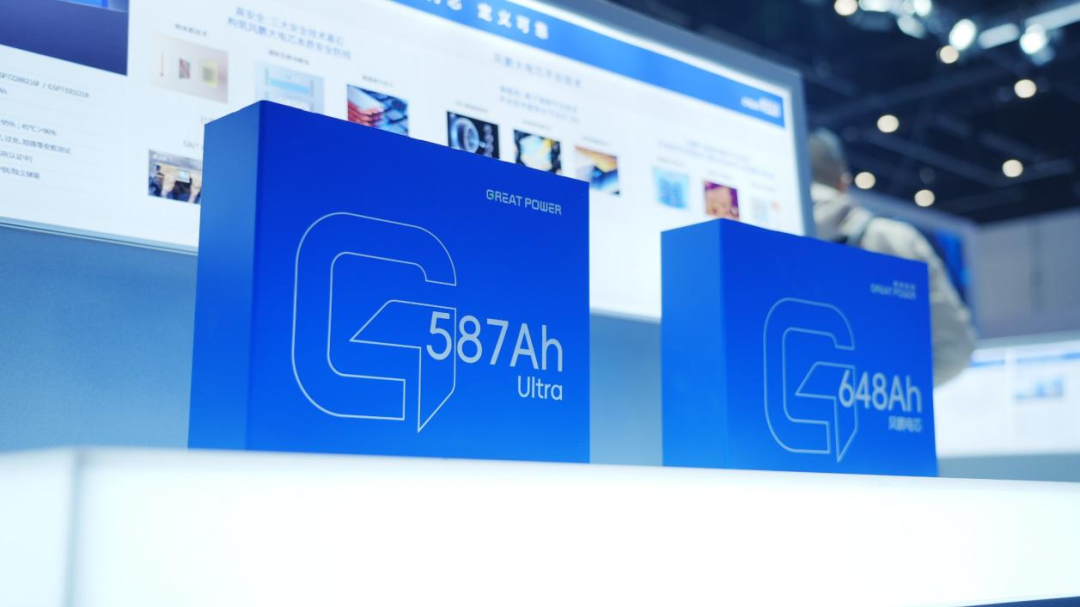
The Capacity Leap — Why Bigger Cells Matter for Utility-Scale BESS
The following table compares the 587 Ah cell against the two previous industry-standard formats:| Parameter | 280Ah Cell (Industry Baseline) | 314Ah Cell (Industry Baseline) | Great Power 587Ah |
| Nominal Capacity | 280 Ah | 314 Ah | 587 Ah |
| Cell Count Per MWh | Baseline | ~15% fewer vs 280Ah | 1 cell ≈ 1.87 × 314Ah, or 2.1 × 280Ah |
| System Integration Cost | Baseline | Lower vs 280Ah | 10-15% lower vs 314Ah systems |
| Volumetric Energy Density | Baseline | Improved vs 280Ah | ~20% higher vs 314Ah |
| Cycle Life | ~8,000-10,000 | ~10,000 | >10,000 |
| Energy Efficiency (25°C) | ~93-94% | ~94-95% | >95% |
| System-level (20-ft container) | ~3.4 MWh | ~5.0 MWh | 6.25 MWh |
For project developers evaluating energy storage system cells, the relevant metric is system-level cost per MWh, not cell-level price per watt-hour. Large-format cells shift more of the value from integration labor into cell manufacturing, where quality control is tighter and unit economics scale with volume.
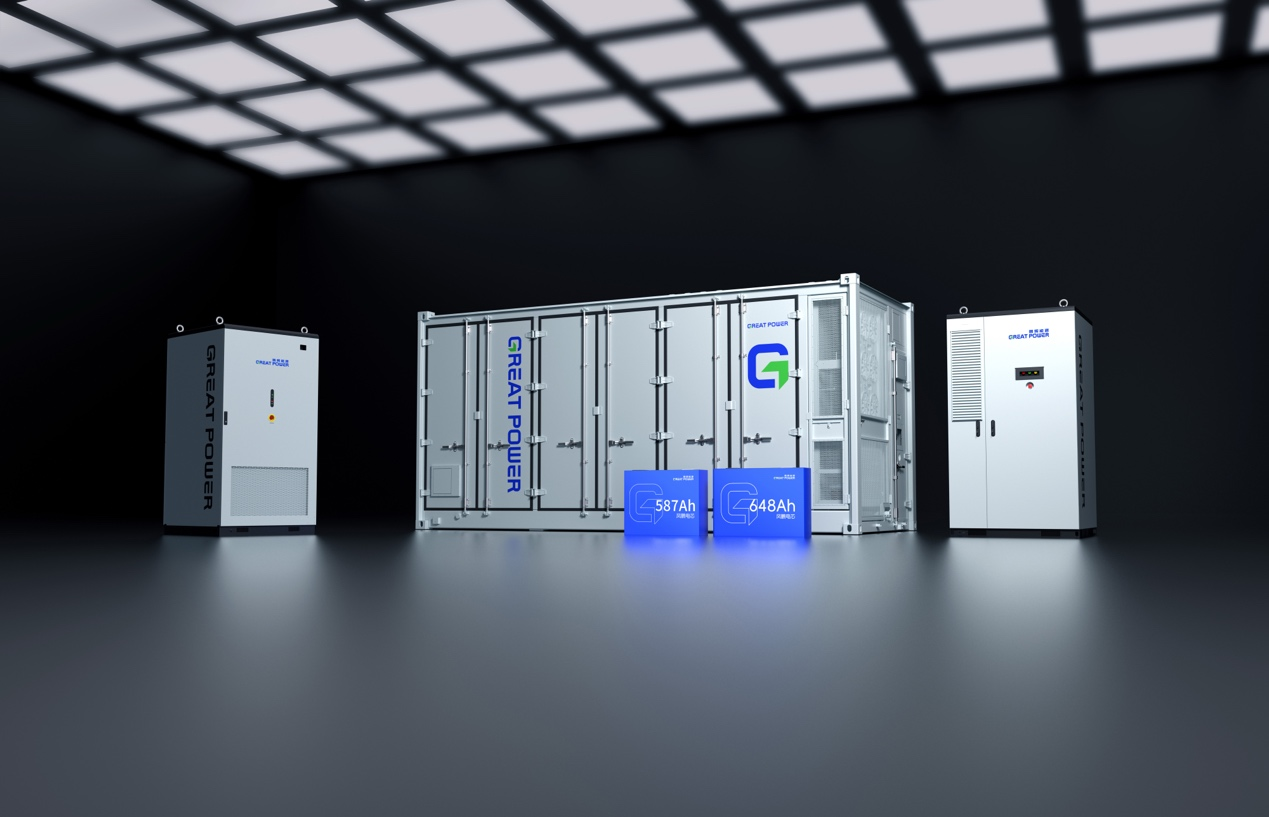
Ultra Cell Technology — Four Engineering Pillars
The 587 Ah cell achieves its performance through four simultaneous innovations, not simply scaling up dimensions. Each addresses a specific engineering constraint that emerges when moving from 314 Ah to 587 Ah format.1. High Safety — Honeycomb Carbon Cooling Structure
The honeycomb carbon cooling structure inside the 587 Ah cell provides multiple parallel heat dissipation paths that contain thermal runaway at the cell level, preventing any single cell failure from propagating to adjacent cells. In nail penetration testing, the cell passes without fire or explosion.LFP chemistry provides a thermal safety margin over NMC: LFP thermal runaway initiation occurs at approximately 230°C versus approximately 180°C for NMC [2]. LFP also does not release oxygen during decomposition, eliminating the secondary combustion risk that drives explosion hazards in other chemistries [2]. As cell dimensions increase, the surface-area-to-volume ratio decreases, making internal heat dissipation more difficult — the honeycomb structure directly addresses this challenge.
This matters for system-level certification. UL 9540A, in its 2025 edition, now requires worst-case cell position testing and introduces the Thermal Runaway Propagation Time (TRPT) measurement [2]. A cell that contains thermal runaway at the cell level — rather than relying on module-level countermeasures — simplifies the path to system-level certification.
2. High Efficiency — "No-Degradation" Technology
The 587 Ah cell uses a self-healing solid electrolyte interphase (SEI) film. The SEI layer is the interface between the anode and the electrolyte that forms during the first cycles and governs long-term capacity retention. In conventional LFP cells, the SEI layer progressively thickens over cycling, consuming active lithium and increasing internal resistance.Great Power's micro-nano structural design enables the SEI layer to repair itself during cycling rather than thickening. This results in >95% round-trip efficiency at 25°C, sustained over 10,000+ cycles. For comparison, conventional LFP cells typically show round-trip efficiency dropping to approximately 93-94% after several thousand cycles [4].
The practical impact: a project operator running daily cycles on a 6.25 MWh system retains roughly 1-2% more sellable energy per cycle after 5,000 cycles compared with conventional LFP cells. Over a 15-year project life, this 1-2% per-cycle efficiency premium translates directly into measurable revenue gains at the project level.
3. Wide Temperature Adaptability — LTSC Technology
Low-Temperature Superconducting (LTSC) technology enables the 587 Ah cell to operate across a wider temperature range without the external heating or cooling that imposes an energy penalty.This is relevant for installations in regions with wide seasonal temperature swings: Northern China, Central Asia, and parts of North America where winter ambient temperatures fall below -20°C and summer peak temperatures exceed 40°C. At these sites, parasitic energy draw for thermal management can reach 5-10% of stored energy annually in conventional systems [5].
The LTSC technology reduces the need for active thermal conditioning, which simplifies system design and improves net round-trip efficiency for the project as a whole.
4. AIDC-Ready — Built for AI Data Center Demands
The 587 Ah cell serves AI data center battery markets by combining a large-format thermal mass with its honeycomb cooling structure, enabling it to absorb repeated 1C high-rate discharge pulses across 60,000+ operating cycles. AI data centers (AIDCs) create a new demand category for utility-scale BESS cells, requiring high-rate discharge capability for UPS and grid support. The International Energy Agency reports data center UPS additions grew 30% to 45 GW in 2025 [3].For developers serving both grid-scale and data center customers with energy storage system cells, a single cell platform that meets both duty profiles simplifies procurement and qualification.
Manufacturing at Scale — 300+ Process Steps, 100% Inspection
A cell design is only as good as the factory that builds it. Consistency at the gigawatt-hour scale requires precision manufacturing. Great Power operates 300+ process control points from electrode coating to final formation.Every cell passes 100% automated optical inspection (AOI) — not batch sampling. This means each 587 Ah cell is individually checked for electrode alignment, coating defects, and dimensional accuracy before leaving the production line.
The electrode coating environment is maintained at ≤1% humidity. This is critical for LFP cathode consistency because moisture contamination during coating introduces irreversible capacity loss and accelerates cell aging [5]. Tight humidity control is one of the operational practices that separates tier-1 manufacturers from the rest. Great Power has maintained BNEF Tier 1 status for seven consecutive quarters, reflecting consistent manufacturing output and bankability [1].
The result: cell-to-cell capacity variation is controlled within tight tolerances. For system integrators, this means simpler BMS design (fewer balancing circuits needed) and longer string life (weaker cells do not drag down string performance prematurely).
How to Evaluate Large-Capacity Cells — A Buyer's Checklist
Not all 500Ah+ LFP cells deliver the same system-level performance. Price per watt-hour varies significantly across suppliers, but the total cost of ownership depends on factors that are not always visible on a datasheet. Ask suppliers these four questions.1. Ask for system-level energy density, not cell-level.
A 587 Ah cell that enables 6.25 MWh per 20-foot container is more meaningful than a cell-level Wh/kg number. System density accounts for thermal management, structural enclosure, and electrical integration overhead — all of which vary across cell formats. A supplier that can only quote cell-level Wh/kg may not have validated the cell inside a container.
2. Ask for cycle life data at your project's operating temperature and depth of discharge (DoD).
Datasheet numbers at 25°C, 0.5C, 80% DoD are an industry-standard starting point. Real operating conditions differ. Request test data at 35-40°C and at your target DoD profile. Cycle life can drop by 40-50% at elevated temperatures [4], and the degradation curve accelerates non-linearly.
3. Ask for manufacturing consistency data — not just a spec sheet.
Cell-to-cell capacity variation after formation, electrode coating thickness uniformity, and electrolyte fill consistency all affect string-level performance. A tier-1 manufacturer should provide statistical process control data — CpK values for key parameters — upon request. If the supplier cannot or will not share this data, the cell design may not be production-ready at scale.
4. Ask for UL 9540A test results at the cell level.
Cell-level thermal runaway characterization is the foundation for module- and system-level certification. The 2025 UL 9540A edition introduced Level 1 (cell-level) and Level 2 (module-level) testing requirements that feed into TRPT calculations [2]. Request test reports for the specific cell model, not a generic chemistry-level certificate.
Red flag: If a supplier cannot provide system-level density data or manufacturing consistency data, the cell design may not be ready for volume production.
Conclusion
The 587 Ah cell represents the industry's transition toward larger-format LFP for utility-scale BESS. Three points summarize the shift:1. Fewer cells per MWh reduce system cost. Each component eliminated — busbar connection, temperature sensor, BMS channel — improves reliability and lowers integration cost. A 20-foot container at 6.25 MWh requires fewer cells than a 5.0 MWh container using 314 Ah cells.
2. Cell-level safety engineering determines system-level performance. The honeycomb carbon cooling structure and self-healing SEI technology address the thermal and degradation challenges that emerge when cell capacity increases to 587 Ah.
3. Manufacturing precision matters as much as cell design. At gigawatt-hour scale, cell-to-cell consistency determines whether a 6.25 MWh system delivers its rated energy through year 10 or degrades prematurely.
For project developers evaluating next-generation energy storage system cells, the 587 Ah cell offers a validated path to lower system cost and higher container density. Talk to Great Power's application engineers about integration requirements for your specific project.
References
[1] BNEF, "1H 2026 Energy Storage Market Outlook," BloombergNEF, 2026.[2] UL Solutions, "UL 9540A: Standard for Test Method for Evaluating Thermal Runaway Fire Propagation in Battery Energy Storage Systems," 5th ed., 2025.
[3] International Energy Agency, "Global Energy Review 2026," IEA, 2026.
[4] S. Gowda et al., "Life Cycle Testing and Reliability Analysis of Prismatic LFP Cells," International Journal of Sustainable Energy, 2024.
[5] Z. Yang et al., "Study on Influencing Factors of Calendar and Cycle Aging of LFP Batteries," Applied Sciences, 2025.
 Consulting & Services
 Great Power