


 Date:2025.11.11
 Views: Loading


A Data-Driven Look at Gen-1 Sodium-Ion Battery Technology
To understand the gap between Gen-1 technology and the mainstream market, we can compare the specs of the first-to-market sodium-ion EV with a best-in-class LFP competitor in the same A00 segment.| Metric | Gen-1 Sodium-Ion EV | Benchmark LFP EV |
| Battery Chemistry | Sodium-Ion (Layered Oxide) | Lithium Iron Phosphate (LFP) |
| CLTC Range | 252 km | 215 km (Comparable Model) |
| Battery Capacity | ~25 kWh (Est.) | 17.3 kWh |
| Energy Efficiency | ~10.1 km/kWh | ~12.4 km/kWh |
| Cell Energy Density | ~140 Wh/kg (HiNa) | ~120-180 Wh/kg (Industry Avg.) |
- Energy Density: While the Gen-1 cell-level density of 140-160 Wh/kg is approaching LFP (which averages 160-180 Wh/kg), the system-level impact is clear. The sodium-ion EV requires a much larger battery pack (25 kWh vs. 17.3 kWh) to achieve a comparable range, leading to higher weight, cost, and a poor "km/kWh" efficiency ratio.
- Cycle Life: Current industry data shows Gen-1 sodium-ion batteries typically achieve a cycle life of 2,000 to 2,500 cycles. This is significantly lower than mature LFP power batteries, which regularly exceed 3,000 cycles, and LFP energy storage cells, which can surpass 5,000 cycles.
- Low-Temperature Performance: This is the undisputed advantage. In harsh -20°C (-4°F) conditions, sodium-ion batteries can retain over 88-90% of their capacity, whereas LFP performance often plummets to 70% or less.
- First Cycle Efficiency (FCE): This is the key technical weakness. Gen-1 cells, which rely on hard carbon anodes, suffer from a low FCE of only 80-85%. This means that during the first charge, 15-20% of the active sodium ions are permanently consumed in the formation of the Solid Electrolyte Interphase (SEI) layer. This "lost" capacity is paid for by the customer but can never be used, which directly inflates the real-world cost and lowers the usable energy density.
The Gen-1 Sodium-Ion Battery Bottlenecks
These data points are not just numbers; they translate directly into three core business and engineering challenges that block the sodium ion battery from mainstream adoption.Challenge 1: The Density Ceiling
The combination of a modest $140-160 Wh/kg cell density and a poor <85% FCE creates a hard ceiling. This combination makes it commercially unviable to build a mainstream EV (A-class or larger) with a 400-600 km range. The battery pack would be excessively large and heavy, compromising vehicle efficiency and design. This has, so far, locked the sodium-ion battery for EV market into short-range applications only.Challenge 2: The Lifetime Economics
While sodium resources are cheap, the battery's economic value is measured by its Total Cost of Ownership (TCO) or Levelized Cost of Storage (LCOS). In high-frequency applications like energy storage, commercial vehicles, or e-bikes, cycle life is the dominant factor. A 2,500-cycle life simply cannot compete in these high-value markets, where LFP batteries offer 4,000, 6,000, or even more cycles. This has blocked Gen-1 sodium-ion from the trillion-dollar energy storage market.Challenge 3: Material Immaturity
These bottlenecks are all symptoms of immature first-generation materials. The hard carbon anode is the primary culprit for the low FCE. First-generation cathode materials lack the capacity and stability to push energy density higher. And the electrolyte systems are still being optimized to form stable SEI layers for long-term cycling.This creates a vicious cycle: Na-ion needs massive scale to achieve its cost potential, but it cannot achieve scale until it breaks into mainstream markets. And it cannot enter those markets with the performance bottlenecks of Gen-1 technology.
Great Power's Next-Generation Solution
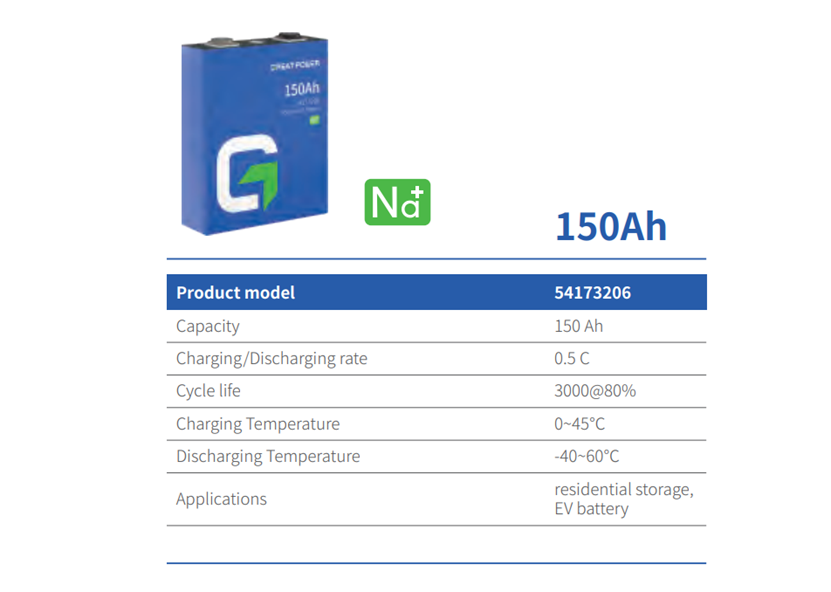
These Gen-1 challenges are not fundamental laws; they are engineering problems. At Great Power, our R&D on sodium ion battery technology began in 2019, specifically targeting these core bottlenecks.While others were focused on just getting to market, we were focused on getting the technology right. The result is a next-generation solution that definitively solves the performance gaps that limit Gen-1 products.
| Performance Bottleneck | Gen-1 Industry Standard | Great Power's Next-Gen Solution |
| Energy Density | 100 - 150 Wh/kg | Up to $150 Wh/kg |
| Cycle Life (RT) | 2,000 - 2,500 cycles | >3,000 (Layered) / >6,000 (Polyanion) |
| First Cycle Efficiency | 80 - 85% | >92% |
1. Solved: The Density Ceiling
Our layered oxide sodium-ion cells have achieved a best-in-class energy density of 150 Wh/kg. More importantly, we achieved this density while creating an "optimal balance" of performance, safety, and cycle life. This density level, combined with our FCE and cycle life breakthroughs, expands the application of sodium-ion from A00-class cars to A0-class vehicles, high-performance e-bikes, and residential energy storage.2. Solved: The Lifetime Economics
We have achieved a revolutionary breakthrough in cycle life. Through our proprietary "bionic self-repairing SEI film technology" and advanced electrolyte additives, we have built a highly stable and low-resistance interface that dramatically suppresses side reactions.This innovation allows us to offer a "dual-track" product strategy that redefines the economic model for sodium-ion:
- EV Grade (Layered Oxide): We have pushed the cycle life to >3,000 cycles. This meets the demanding requirements of mainstream EV applications and matches the performance of high-quality LFP batteries.
- ESS Grade (Polyanion): We have achieved an astounding >6,000 cycles. This is a killer product for the grid-scale energy storage market. It not only competes with—but in many cases exceeds—the lifespan of long-duration LFP systems, making sodium-ion a more attractive economic choice for grid stabilization.
3. Solved: The First Cycle Efficiency
We tackled the low-efficiency problem at its root. Through deep innovation in hard carbon anode pre-treatment processes, Great Power has successfully raised the FCE from the industry's 80-85% average to over 92%. This 7-12% improvement is a massive gain. It means our customers get to use the capacity they pay for. It lowers the real-world cost per-watt-hour, eliminates the need for costly "over-design," and maximizes the usable energy in every single cell.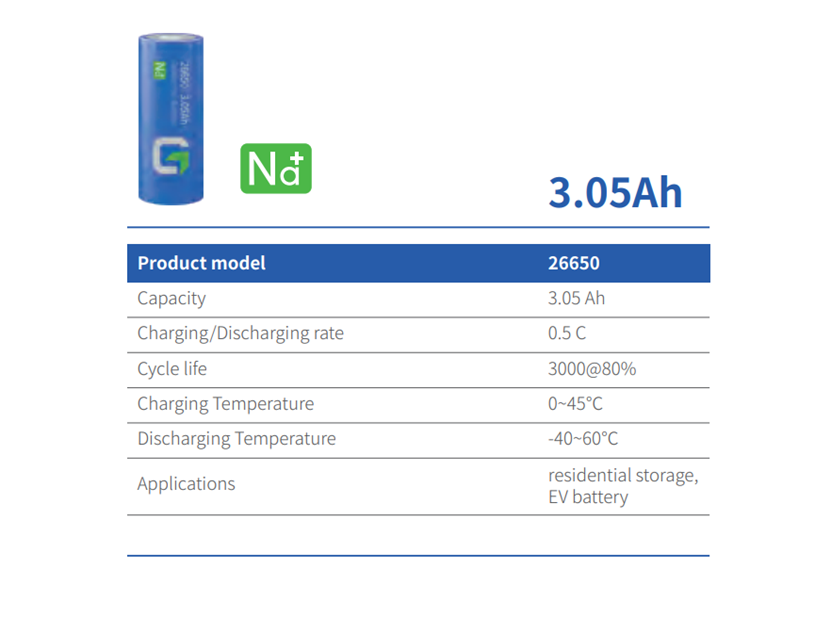
 Consulting & Services
 Great Power